
Medical Informatics: Digital Revolution Advancing Global Health & Patientcare

Medical Informatics in Global Healthcare
Medical Informatics (MI), also known as Health Informatics (HI), Clinical Informatics, or Biomedical Informatics—is a rapidly evolving interdisciplinary field that integrates medicine, computer science, information science, engineering, and healthcare management. Its core purpose is to enhance the way health information is collected, stored, analyzed, and applied to improve patient care, public health, and healthcare system performance worldwide.
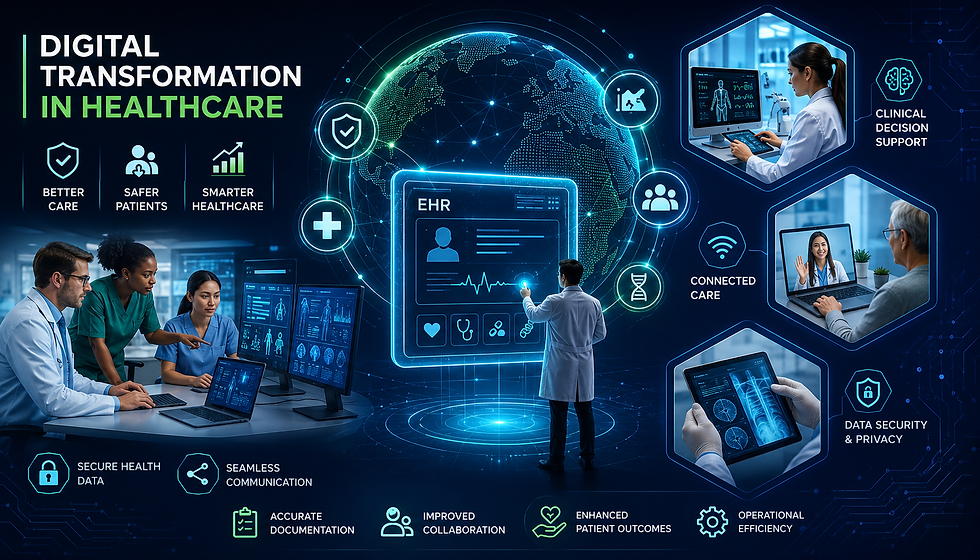
Digital transformation is reshaping healthcare by changing how medical information is collected, stored, shared, and used. Medical informatics and electronic health records (EHRs) enhance care quality, patient safety, and operational efficiency by supporting accurate documentation, communication, and clinical decision‑making. Technologies such as telemedicine, EHRs, and artificial intelligence (AI) are central to this shift, creating a more connected, efficient, and patient‑centered healthcare system. They expand access to care and improve the diagnosis, treatment, and management of health conditions.
Medical informatics in global healthcare, integrates healthcare science with information technology to ensure that patient data is effectively used to improve diagnosis, treatment, healthcare management, and research. The responsible use of digital health data also requires strong attention to compliance, privacy protection, and ethical standards to maintain patient trust in healthcare systems. Across the world, healthcare systems differ in structure, financing, and technological maturity. Despite these differences, every nation faces similar challenges: rising healthcare costs, aging populations, chronic disease burdens, and the need for efficient, data‑driven care.

Medical informatics provides the digital foundation to address these challenges by enabling:
Evidence‑based clinical decision-making
Efficient health information exchange
Improved patient safety and quality of care
Scalable public health surveillance
Integration of emerging technologies such as AI, IoT, and telemedicine
As global health becomes increasingly interconnected, Medical Informatics serves as the backbone for international health data standards, interoperability, and collaborative research.
Key Technologies Driving Change in Medical Informatics
Electronic Health Records (EHRs)
Electronic Medical Records (EMR) and Electronic Health Records (EHR) represent the foundation of modern health information systems and Medical Informatics. These digital systems enable healthcare professionals to maintain accurate and organized patient records while ensuring timely access to medical histories, laboratory results, diagnostic imaging, medications, and treatment plans. The global adoption of digital health technologies has been encouraged by international health organizations to strengthen healthcare systems and promote safe, coordinated care.
Artificial Intelligence (AI)
AI uses algorithms and machine learning (ML) to analyze large amounts of medical data. It can identify patterns that humans might miss, helping with early diagnosis, predicting disease outbreaks, and personalizing treatments. AI tools assist radiologists in detecting tumors from imaging scans and help pathologists analyze biopsy samples more accurately. AI enhances diagnostic accuracy by analyzing medical data with speed and precision. It supports clinical decision‑making through predictive analytics and risk assessment. AI automates routine administrative tasks, improving workflow efficiency. It enables personalized treatment plans based on patient‑specific data patterns. AI-powered tools expand access to care through virtual assistants and remote monitoring.
Telemedicine
Telemedicine expands access to care, especially for remote or underserved communities. It reduces travel time and costs for patients while improving appointment convenience. Healthcare providers can monitor chronic conditions more efficiently through virtual follow‑ups. Telemedicine supports faster triage and timely clinical decision‑making. It enhances continuity of care by enabling secure communication between patients and providers.
Benefits of Digital Transformation and Medical Informatics in Healthcare
Improved Patient Outcomes
Digital tools enable faster and more accurate diagnoses, leading to timely treatments. Remote monitoring devices allow continuous tracking of chronic conditions such as diabetes or hypertension, helping patients manage their health better. Telemedicine also supports mental health care by providing easier access to counseling and therapy.
Enhanced Data Accessibility
Healthcare providers can access patient data anytime and anywhere, improving decision-making. Patients gain more control over their health information, promoting transparency and engagement. Data sharing across institutions supports research and public health monitoring. Medical Informatics is really helpful for healthcare professionals.
Increased Efficiency in Healthcare Delivery
Digital systems reduce paperwork and administrative tasks, freeing up time for clinicians to focus on patient care. Automated appointment scheduling, billing, and prescription management streamline operations. Telemedicine cuts down on unnecessary hospital visits, reducing costs and wait times.
Medical informatics integrates healthcare science with information technology to ensure that patient data is effectively used to improve diagnosis, treatment, healthcare management, and research. The responsible use of digital health data also requires strong attention to compliance, privacy protection, and ethical standards to maintain patient trust in healthcare systems.
Challenges Faced by Healthcare Systems Worldwide
Digital Transformation and Medical Informatics-Data Privacy and Security
Protecting patient information is critical. Digital systems are vulnerable to cyberattacks and data breaches. Ensuring strong security measures and compliance with regulations like GDPR is essential to maintain trust.
Infrastructure and Access
Not all regions have reliable internet or digital devices, limiting the reach of telemedicine and EHRs. Investments in infrastructure and training are needed to bridge this gap, especially in low-income countries.
Interoperability Issues
Different healthcare providers often use incompatible systems, making data sharing difficult. Standardizing formats and protocols is necessary to create seamless communication across platforms.
Resistance to Change
Healthcare professionals may be hesitant to adopt new technologies due to lack of training or fear of increased workload. Clear benefits, user-friendly designs, and ongoing support help ease this transition.
Looking Ahead: Digital Transformation and Medical Informatics- The Future of Healthcare
Digital transformation is setting the stage for a healthcare system that is more patient-focused, data-driven, and accessible. As digital health continues to evolve globally, understanding the principles of medical informatics and responsible data management has become essential for healthcare professionals and healthcare administrators. As technologies evolve, we can expect more personalized treatments, better disease prevention, and improved global health outcomes. Collaboration between governments, healthcare providers, and technology developers will be key to overcoming challenges and ensuring that digital tools benefit everyone. However, digital transformation introduces risks such as data breaches, system errors, and privacy vulnerabilities. Healthcare organizations must implement strong safeguards to ensure secure, ethical, and reliable use of digital tools.
Overall, healthcare systems that embrace these changes will be better equipped to meet the needs of their populations and respond to future health crises. In the era of Digital Transformation and Medical Informatics, patients are expected to have more control over their health journeys, supported by timely information and connected care networks.
HEALTH INFORMATICS CERTIFICATE PROGRAM at Springfield College helps you develop the knowledge and skills needed to work efficiently as knowledgeable healthcare personnel in a health care setting. This program prepares students to gain the essential knowledge and information to work as a responsible healthcare staff in variety of medical, dental & healthcare facilities such as physician’s clinic, specialist’s office, dentist’s office, dental hygienist’s office, nursing homes and hospital setups.
Diploma in Medical Office Administration (MOA) Program at Springfield College provide training to produce knowledgeable and well-informed Healthcare Administrators who are adept at adjusting to new developments in health care regulations, technology and policies. They become flexible, analytical and organized in applying learned knowledge, skills and clinical expertise into their medical practice at workplaces.
References:
Information Technology Resources. Available at: https://www.himss.org/resources/digital-health
Medical and Health Informatics. Available at: https://imia-medinfo.org/wp/
You can also read the following:
For details of HEALTH INFORMATICS CERTIFICATE PROGRAM &best learning-
CONTACT:
#19-1- Bartley Bull Pkway
(Across Shoppers World Brampton, Above Food Basics)
Brampton, ON, L6W 3T7
Tel: 905-216-1600
E-Mail: admin@springfieldcollege.ca

Comments